
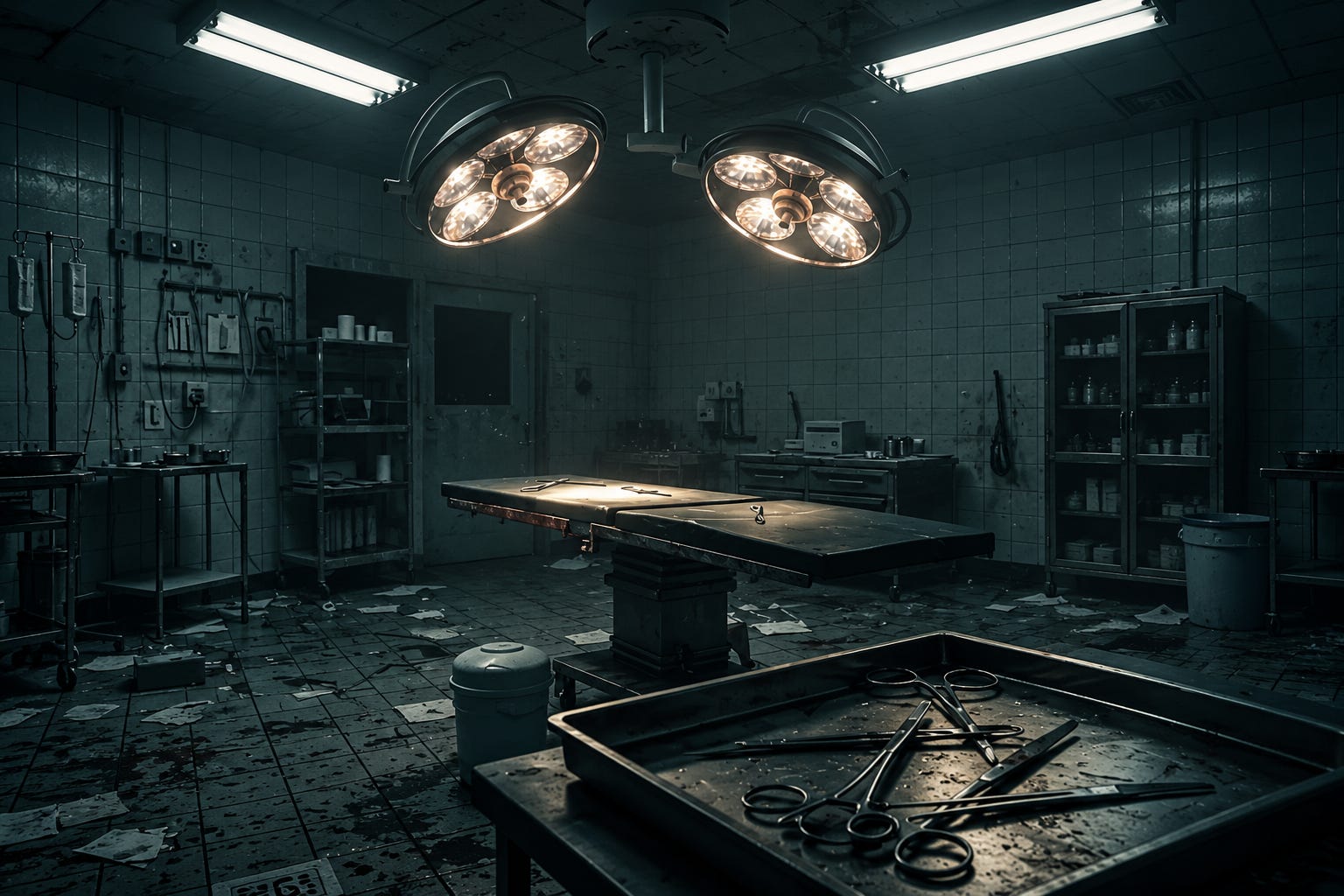
The door slid open a little farther.
And I saw everything.
Not one table.
Rows of them.
The room was enormous.
For a second, my mind refused to understand what my eyes were looking at.
Naked men and women lay on operating tables beneath harsh lights.
Young men.
Young women.
Some completely still.
Others weren’t.
Teams surrounded them in gowns, masks and gloves, moving with the speed of people who had done the same thing hundreds of times.
Monitors stood beside the tables.
Screens everywhere.
Heart rates.
Blood pressure.
Numbers I didn’t understand.
Machines breathed.
Pumps hummed.
Metal struck metal.
And beneath all of it,
screaming.
One scream came from somewhere near the middle of the room.
Another answered from farther away.
A young man twisted against the restraints holding his arms.
Three people worked around him.
One of them didn’t even look at his face.
“Hold him.”
Someone pressed his shoulder down.
The man screamed again.
His voice cracked halfway through.
I couldn’t look away.
His body had been opened.
Not butchered.
That would have been easier to understand.
This was precise.
Controlled.
Clinical.
They weren’t simply killing people.
They were keeping them alive.
That was the part my mind understood first.
They needed them alive.
At the next table, a woman lay motionless beneath the lights. A tube ran into her arm. Her eyes were closed.
At another, someone’s eyes fluttered weakly beneath half-lowered lids.
Drowsy.
Barely conscious.
At another,
a girl was awake.
Completely awake.
She couldn’t have been much older than me.
Her head moved slowly from side to side while tears disappeared into her hair.
Something had been placed between her teeth.
Her body jerked.
The monitor beside her began screaming.
One of the workers looked at the screen.
“More.”
Someone adjusted the line connected to her arm.
The girl’s body relaxed.
For maybe three seconds.
Then she screamed again.
I stepped backward.
The bag slipped in my hand.
Clink.
A woman near the closest table looked up.
Our eyes met.
She looked at me for less than a second.
Then went back to work.
That frightened me almost as much as the room.
Nobody was hiding.
Nobody was panicking.
Nobody was behaving as though something terrible was happening.
This was work.
“Khaleel.”
I turned.
Melody’s father stood farther down the corridor.
Watching me.
Everything Melody had told me came back at once.
Whatever you see... don’t react.
My father notices everything.
And her mother’s voice.
Keep a calm face.
My heart was beating so hard I could feel it in my throat.
I forced my fingers around the handle of the bag.
Forced my face still.
Then walked toward him.
He looked past me toward the room.
Then at me.
“First time?”
I nodded.
“Yes.”
He studied my face.
I waited.
Then he turned.
“Come.”
That was all.
I followed.
But something had already changed.
I knew what the Dome was.
Maybe not all of it.
Maybe not who controlled it.
Maybe not where those people came from or where whatever was being taken from them eventually went.
But I understood enough.
People came here alive.
They were opened.
Things were taken from them.
And somewhere outside this forest, somebody was waiting for those things.
The Dome was a maze.
I realised that within minutes.
Corridors divided without warning. Some narrowed. Others opened into enormous work areas. Staircases disappeared downward. Secured doors appeared at intersections, some requiring keys, others cards.
There were no windows.
After three turns, I wasn’t sure which direction we’d come from.
After six, I wasn’t sure I could find the exit again.
People moved around us constantly.
Some wore scrubs.
Some wore ordinary clothes.
Some pushed equipment.
Some carried sealed containers.
Others stood at doors with nothing in their hands.
Nobody stopped Melody’s father.
That was the first thing I noticed.
A man opened a secured door before we reached it.
Another stepped aside.
Someone passing us nodded.
“Morning.”
Melody’s father returned the nod.
We kept walking.
I looked at him differently now.
Until that moment, I’d assumed he was simply one of the people who worked here.
I was wrong.
People knew him.
And more importantly
they moved for him.
At one junction, a younger man in scrubs approached him with a clipboard.
“Sir.”
Melody’s father stopped.
The man lowered his voice.
“Three is unstable.”
“Then don’t touch him.”
The younger man nodded immediately.
“Yes, sir.”
He left.
I watched him go.
That one conversation told me more than I wanted to know.
Melody’s father wasn’t one of the men carrying bodies through corridors.
He wasn’t one of the people cleaning instruments.
He wasn’t security.
Whatever he was,
he had rank here.
We eventually reached another section of the Dome.
Quieter.
Fewer people.
The screaming from the large room faded behind several doors until only the mechanical hum of the building remained.
He stopped outside a door.
Unlocked it.
Inside was another operating room.
Smaller.
Controlled.
Two people were already waiting.
A man and a woman.
Both dressed for theatre.
The woman looked at Melody’s father.
“You’re late.”
He glanced at his watch.
“No.”
She checked hers.
Then smiled.
“Two minutes.”
He placed the black bag on a counter.
The man beside her noticed me.
“Who’s this?”
Melody’s father opened the bag.
“My wife’s nephew.”
The man looked at me.
“Since when does your wife have a nephew?”
My stomach dropped.
Melody’s father didn’t even look up.
“Since her sister had a son.”
The woman laughed.
The man shrugged.
And just like that, the moment passed.
I didn’t breathe properly again until they turned away.
Melody’s father removed his watch.
Then his shirt.
He washed his hands.
The woman handed him a gown.
Everything about him changed.
Not his face.
His movements.
At home, he had seemed slow.
Quiet.
Almost indifferent.
Here, every movement had purpose.
People waited for his instructions.
“What am I doing?” I asked.
He looked at me.
“Watching.”
That wasn’t the answer I wanted.
He pointed toward the wall.
“Stand there.”
I did.
A side door opened.
Two workers pushed in a trolley.
There was a man on it.
Alive.
Sedated, but alive.
His eyes were partially open, struggling to focus.
Then they found me.
I knew that look now.
Help.
The same look I’d seen through the first door.
I looked away.
“Khaleel.”
I turned toward Melody’s father.
He was pulling on his gloves.
“Watch.”
I didn’t want to.
“You’re here to learn.”
The assistants transferred the man onto the table.
Straps went across his wrists.
His ankles.
His chest.
Whatever they had given him wasn’t enough.
He started fighting.
“No... no...”
One of the assistants adjusted something beside him.
“Please.”
His voice grew louder.
“Please. Please, I have children.”
Nobody answered.
“Please.”
Melody’s father stepped beneath the light.
The man looked at him.
“Brother, please.”
Melody’s father held out his hand.
An instrument was placed into it.
Then he looked at me.
“Watch.”
So I watched.
I watched his assistants respond before he finished speaking.
I watched the monitors.
I watched how calm he remained.
I watched everyone in that room treat him like the person who knew exactly what needed to happen next.
And I watched the man on the table slowly understand that begging wasn’t going to save him.
I don’t know how long we were inside that room.
It felt like hours.
Maybe it was.
When we finally left, my legs felt different.
Like they belonged to somebody else.
That was my first day inside the Dome.
Or at least,
the first half of it.
Lunch was when the Dome became worse.
Because monsters weren’t supposed to eat jollof rice.
There was a dining hall.
An actual dining hall.
Plastic chairs.
Long tables.
Fans turning overhead.
People laughing.
Someone had music playing quietly from a phone.
A television in one corner showed football highlights.
I stood at the entrance for a moment.
I couldn’t understand it.
Less than twenty minutes earlier, I’d watched a man beg for his life.
Now somebody was complaining that there wasn’t enough pepper in the stew.
Melody’s father sat.
I sat opposite him.
I couldn’t eat.
He could.
Around us, conversations overlapped.
Football.
Money.
Fuel prices.
Ordinary problems.
Ordinary lives.
Then a sentence from the table behind me cut through everything.
“How many on Friday?”
Another voice answered.
“Thirty-five.”
My spoon stopped.
I didn’t turn around.
“Full?”
“Full.”
“That’s too soon. We’re still clearing this group.”
“Tell upstairs.”
A laugh.
“You tell upstairs.”
Someone else joined them.
“Pickup point changed too.”
“Again?”
“Apparently.”
“Website updated?”
“Already done.”
My fingers tightened around the spoon.
Website.
Thirty-five.
Pickup.
I stared at my food.
For a second, I was back home.
Phone in my hand.
The photographs.
The forests.
The promise of something different.
THE GETAWAY.
Free.
Thirty-five guests.
Transportation provided.
All you had to do was register.
All you had to do was show up at the location they sent you.
No office.
No organizer to meet.
No number to call.
No one to ask questions.
I had thought that was convenience.
Now I understood.
It was design.
The spoon in my hand trembled.
“Khaleel.”
I looked up.
Melody’s father was watching me.
“Food is getting cold.”
I forced my hand still.
“Sorry.”
I ate.
Behind me, the conversation continued.
“Last batch had problems.”
“Driver?”
“No. One jumped.”
Everything inside me stopped.
I didn’t move.
Didn’t breathe.
The man continued.
“Before arrival?”
“Apparently.”
Another voice laughed.
“Then he’s probably feeding something in the forest.”
My mouth went dry.
One jumped.
Me.
They were talking about me.
“Did they search?”
“For what? Forest is enough.”
A few people laughed.
I lowered my eyes.
Melody’s father continued eating.
Slowly.
Calmly.
I couldn’t tell whether he was listening.
I couldn’t tell whether he knew.
Then the man behind me said,
“Other thirty-four made it.”
My heart slammed against my ribs.
Thirty-four.
Saleem.
Suzzy.
I almost turned.
Almost.
But Melody’s voice came back.
My father notices everything.
I lifted another spoonful of rice.
Put it into my mouth.
Chewed.
Swallowed.
It tasted like nothing.
Thirty-four made it.
That meant they had reached the Dome.
And if they had reached the Dome,
they could still be here.
The second day was worse.
Because I knew what was coming.
I woke before anyone called me.
For several seconds, I lay on the mattress staring at the ceiling.
Then I heard movement from the bedroom.
My stomach tightened.
I knew what those sounds meant now.
He was getting ready for work.
Melody found me before we left.
She didn’t ask what I’d seen.
She looked at my face and knew.
“How bad?”
I stared at her.
“You knew.”
She lowered her eyes.
“You knew exactly what was in there.”
“I knew enough.”
“People are being cut open.”
“Khaleel,”
“They’re taking organs from them.”
“Keep your voice down.”
Her eyes moved toward her parents’ bedroom.
I stared at her.
“You knew.”
This time, she didn’t answer.
Her father’s voice came from inside.
“Khaleel.”
Melody stepped away from me immediately.
I looked at her.
Then he appeared.
The black bag was already in his hand.
He held it toward me.
I took it.
And we went back.
The second day taught me something the first hadn’t.
The Dome wasn’t only about organs.
I saw a man taken through a door that wasn’t connected to any theatre.
He was screaming before the door closed.
Hours later, when we passed that corridor again, I heard someone screaming from behind it.
I couldn’t tell whether it was still him.
I didn’t want to know.
Later, I saw a trolley being pushed toward an elevator.
A sealed container sat on top.
A label had been attached to it.
No name.
Only numbers.
One of the workers accompanying it said,
“This one isn’t medical.”
The other frowned.
“Then where?”
“Ritual.”
He said it the same way someone might say Accra.
A destination.
Nothing more.
I slowed.
Melody’s father didn’t.
I caught up.
That was when I began to understand the true size of the place.
The operating rooms were only one part of it.
Some of what left the Dome was sold for transplants.
Some went elsewhere.
Rituals.
Private orders.
Special requests.
Words passed through corridors as casually as football scores.
Once, I heard two workers talking as we approached a stairwell.
“How much?”
“You don’t want to know.”
“For one person?”
“For watching.”
“Watching what?”
The first man laughed.
“You ask too many questions.”
They saw Melody’s father and immediately moved aside.
I kept walking.
I didn’t ask.
But I understood enough.
There were rich people paying enormous amounts of money simply to witness what happened inside certain rooms.
Not doctors.
Not people trying to save anyone.
People who wanted to watch.
That frightened me differently.
The Dome existed because there were people outside these walls with enough money
and enough darkness inside them,
to make their desires somebody else’s workday.
By the third day, I could find his room without him.
That frightened me.
The Dome was still a maze.
But it was beginning to become my maze too.
I knew which corridor led toward the large theatres.
Which staircase went below ground.
Which doors were always guarded.
Which corridor became colder as you approached it.
Which elevators I was never allowed to enter.
I learned that the enormous room I’d first seen wasn’t special.
There were others.
Holding areas.
Recovery rooms.
Storage rooms.
Operating theatres.
Administrative sections.
Cold rooms.
Loading areas.
And other rooms.
Rooms I sometimes heard before I saw them.
Once, a door opened as we passed.
I saw a chair bolted to the floor.
A man strapped to it.
Someone stood behind him.
Then the door closed.
I didn’t ask.
Another corridor had no screams at all.
That one frightened me more.
Men came and went through secured doors carrying cases.
Once, I saw two people arguing over paperwork.
“That’s not what he paid for.”
“It’s what was available.”
“He specifically requested,”
They noticed Melody’s father.
The conversation stopped.
He looked at them.
They lowered their voices.
We kept walking.
By then, I understood something else.
Somewhere beyond the forest were people willing to buy what came out of these rooms.
People willing to pay for bodies.
People who believed human parts could give them power.
People who paid simply to watch suffering.
And perhaps people whose reasons I still didn’t understand.
I didn’t need to.
The reasons didn’t matter.
Money became an order.
An order became a person.
And that person eventually arrived here.
The website found them.
The buses brought them.
The Dome processed them.
Then pieces of them travelled farther than they ever would.
Places where people arrived.
And places where pieces of them left.
I learned all of this without asking.
Because Melody had been right.
The more I knew,
the harder it became to pretend I didn’t.
And I was learning very quickly.
Too quickly.
By the fourth day, Melody’s father no longer told me to stand against the wall.
That morning, his assistant placed a gown beside me.
I stared at it.
Then at him.
He was preparing his instruments.
“Put it on.”
I didn’t move.
He looked up.
“Khaleel.”
I put it on.
The gloves came next.
I pulled them over my hands.
They felt too tight.
A trolley entered.
There was a girl on it.
Young.
Maybe my age.
Her eyes moved around the room.
Then stopped on me.
She stared.
I looked away.
“Come closer,” Melody’s father said.
I looked at him.
He pointed toward the monitor.
“Watch.”
I did.
The girl began to cry.
Quietly.
No screaming.
No fighting.
Just tears.
That was worse somehow.
Melody’s father held out his hand.
His assistant placed an instrument into it.
Then he looked at me.
“Your hand.”
I froze.
“What?”
He nodded toward the table.
“Here.”
I knew what he wanted.
My body refused.
For a moment, nobody moved.
His assistant looked at me.
Then at him.
The girl looked at me too.
Three pairs of eyes.
Waiting.
I thought about the dining hall.
One jumped.
I thought about the laughter.
Probably feeding something in the forest.
Then the words that had kept me awake all night.
Other thirty-four made it.
Saleem.
Suzzy.
If they were somewhere inside this place, running now would accomplish nothing.
If I wanted to find them,
I needed to stay.
I stepped toward the table.
The girl watched me.
I placed my hand where Melody’s father had shown me.
She flinched beneath it.
For a moment, I couldn’t breathe.
Melody’s father studied me.
Then returned his attention to the table.
The girl closed her eyes.
I didn’t.
This time,
I watched.
Not because I wanted to.
Because somewhere inside this maze were thirty-four people who had been on my bus.
And two of them had names.
Saleem.
Suzzy.
For the first time since entering the Dome, survival wasn’t enough.
I needed to learn this place.
Every corridor.
Every lock.
Every face.
Every routine.
Every mistake.
Because if my friends were still alive,
I was going to find them.
And to do that,
I would have to become very good at pretending I belonged here.
I’m sure you’re tired of me fanboying ATP, but damn, bro.
I’ve read this whole series with my heart in my stomach.
Words have failed me at this point. Elite stuff once again.