
“…you cannot be here when they come home.”
I stared at her.
“Who?”
She didn’t answer.
“We need to go.”
“Go where?”
She unlocked the shop door and opened it just enough to look outside.
Left.
Right.
Then left again.
“Come.”
I didn’t move.
“I’m not following you anywhere until you tell me what’s going on.”
She turned.
“Then stay here.”
She opened the door.
I followed her.
Apparently, almost dying hadn’t made me any better at making decisions.
We slipped out of the shop and around the side of the building.
She moved quickly, keeping close to the walls and stopping before every open stretch between the houses.
I limped after her.
“Slow down.”
She didn’t.
“Some of us jumped out of a bus today.”
That stopped her.
She turned.
“You jumped?”
“Yes.”
“From the bus?”
Her eyes dropped to my knee.
“Can you run?”
“Not particularly.”
That seemed to worry her more than it should have.
“Why?”
“Just keep moving.”
There it was again.
No explanation.
Every question I asked seemed to produce another one.
We crossed behind two houses and entered a narrow passage between a concrete wall and an old wooden fence.
The settlement looked different from back here.
Clothes hung from lines. Children’s slippers sat beside doorways. Somewhere nearby, a chicken complained loudly about something.
Normal things.
I don’t know why that bothered me.
But it did.
Maybe because normal things weren’t supposed to exist this close to whatever I’d heard coming from that Dome.
She stopped in front of a small gate and peered around the corner.
I looked too.
The road was empty.
She opened the gate.
“Quick.”
I followed her inside.
The house wasn’t particularly large.
Cement walls. A small veranda. Two plastic chairs near the entrance.
She knocked twice.
The door opened almost immediately.
A woman stood behind it.
Older.
Maybe late forties.
She looked at the girl first.
Then at me.
Her expression changed.
Her eyes travelled over me.
Torn clothes.
Mud.
Blood.
My knee.
Then my face.
“Who is this?”
“I found him at the shop.”
“What happened to you?”
“It’s a long story.”
“He came from the Whitehouse.”
The older woman looked at her daughter.
Not at me.
Her.
“What?”
“He said he came from the Whitehouse.”
Whitehouse.
So the thing had a name.
“I said I was going there.”
Neither seemed interested in the distinction.
The woman stepped outside.
She checked the gate.
Then the side of the house.
“Did anyone see you?”
There it was again.
“No.”
She looked at her daughter.
“Are you sure?”
“I checked.”
“Checked where?”
“The road was empty.”
“That’s not what I asked.”
Her daughter went quiet.
The woman looked at me.
“Did anyone follow you?”
“No.”
“How do you know?”
I was beginning to get irritated.
“Because I’ve spent the last God-knows-how-long walking through a forest completely alone.”
She studied me.
“Get inside.”
Finally.
Progress.
I stepped through the doorway.
She closed it behind me.
Locked it.
Then drew the curtain.
That killed whatever relief I’d been feeling.
“Okay.”
I looked between them.
“Someone needs to tell me what the hell is going on.”
The older woman walked past me.
“Sit.”
“I’d rather get some answers.”
“And I’d rather you weren’t standing in my house with those mud-covered boots. Now sit.”
I sat.
She disappeared into another room.
The younger woman remained beside the window, pulling the curtain aside barely enough to see outside.
“What’s your name?” I asked.
She hesitated.
“Melody.”
“Khaleel.”
She nodded.
“Your mother always this welcoming?”
Nothing.
Tough crowd.
Her mother returned carrying a small bowl, cotton wool and what looked like antiseptic.
She pulled another chair over and began cleaning the cuts on my arm.
The antiseptic touched an open wound.
I hissed.
“Sorry.”
“It’s fine.”
She continued.
For a while, the only sound in the room was rainwater dripping from the roof.
“My friends are there.”
Her hand stopped.
Just for a second.
Then continued.
“At the Whitehouse?” Melody asked.
“I think so.”
“You think?”
“They were still on the bus.”
Her mother looked up.
“What bus?”
“We were supposed to be going camping.”
Saying it now sounded ridiculous.
“There were about thirty of us. Maybe more. We signed up online. They picked us up this morning and…”
The mother and daughter exchanged a look.
There.
Again.
“What?”
Neither answered.
“What?”
The woman returned to my arm.
“You need to rest.”
“That wasn’t nothing.”
“My best friend is in there. And Suzzy.”
I don’t know why saying her name made everything suddenly feel heavier.
“I left them on that bus.”
The woman tied a strip of gauze around my forearm.
“Then you were fortunate.”
I stared at her.
“Fortunate?”
“Yes.”
“Why?”
She gathered the bloodied cotton.
For a moment, I thought she was finally going to tell me.
Instead:
“You don’t need to know.”
I laughed.
Actually laughed.
“I don’t need to know?”
I stood too quickly.
My knee buckled.
I caught myself against the chair.
“My friends are inside that place and you’re telling me I don’t need to know?”
“Keep your voice down.”
“Then tell me what the hell is happening.”
Melody moved toward me.
“Khaleel…”
“No. You dragged me in here. You sneaked me through this place like I’m not supposed to exist, and every time I mention that white building, both of you look like I’ve broken some kind of taboo.”
The older woman’s expression hardened.
“Knowing won’t help your friends.”
“I’ll decide that.”
“Are you that eager to get yourself killed?”
That shut me up.
The room went very quiet.
She looked away.
And that was when I noticed the photograph.
It sat on a small cabinet behind her.
Three people.
Melody.
Her mother.
And a man.
Tall.
Broad shoulders.
Even in the photograph, he wasn’t smiling.
His arms rested stiffly at his sides while Melody stood beside him, much younger.
A family portrait.
“Your husband?”
The woman’s eyes followed mine.
“Yes.”
“Where is he?”
She didn’t answer.
I already knew I wasn’t going to like it.
Then something sounded somewhere in the distance.
Low.
Mechanical.
A horn.
It rolled across the valley and faded.
Melody’s face changed.
Her mother immediately looked toward the window.
“What was that?”
Melody moved toward the curtain.
Her mother caught her wrist.
“Don’t.”
I looked between them.
“What was that?”
Then I heard something outside.
Far away at first.
An engine.
Then another.
The older woman looked at me.
“Listen carefully.”
Something had changed in her.
The fear hadn’t disappeared.
She’d simply stopped having time for it.
“From this moment, you are my sister’s son.”
I stared at her.
“What?”
“You came from Accra this afternoon.”
“What are you talking about?”
“You need work. I asked you to come because my husband might have something for you.”
“I don’t understand.”
“You don’t need to.”
Another engine sounded outside.
Closer.
Then voices.
A man’s laughter.
Somewhere nearby, a child screamed happily.
“Daa!”
Footsteps rushed past the house.
A motorcycle stopped.
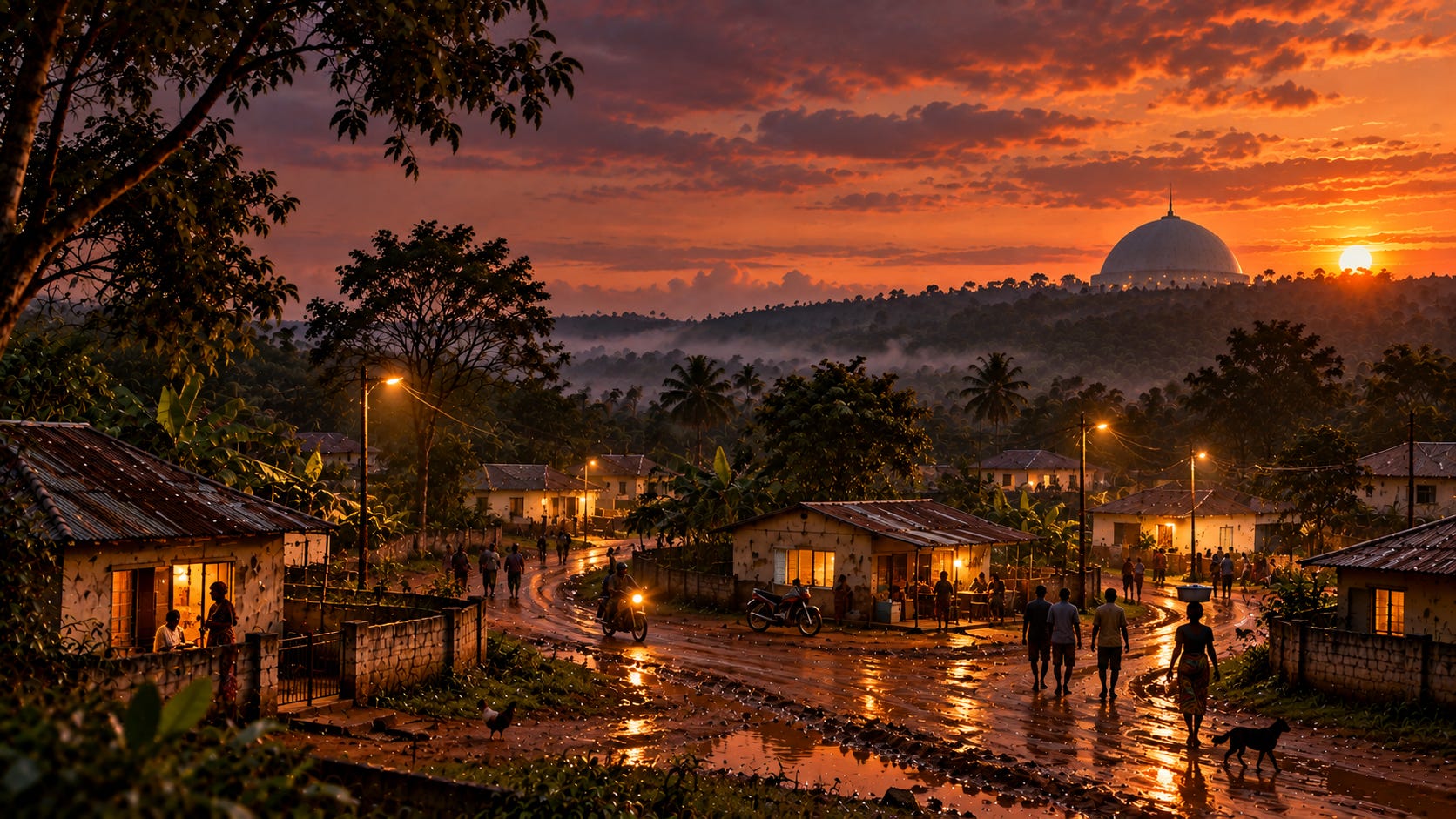
Someone called a greeting.
Another voice answered.
The empty settlement I’d walked into was coming alive.
Except nobody was waking up.
They were coming home.
The woman stepped closer.
“Your name is Khaleel. Keep it. Don’t invent more lies than you can remember.”
My heart was beginning to beat harder.
“Where are they coming from?”
She stared at me.
I already knew.
I just needed her to say it.
She didn’t.
“Whatever happens when my husband walks through that door, you are family.”
“And if he doesn’t believe you?”
She leaned closer.
“Then make him believe me.”
Heavy footsteps sounded outside the gate.
Melody moved away from the window.
The metal latch lifted.
Someone entered the compound.
Then came the slow scrape of boots against wet concrete.
Once.
Twice.
Closer.
The older woman looked at me.
“Khaleel.”
I looked at her.
For the first time since I’d entered the house, she looked genuinely terrified.
Not for herself.
For me.
She lowered her voice.
“Don’t look afraid.”
Finaallyyy